Russian Civil War
Doctor ZhivagoThe Russian Civil War is the widening conflict that makes ordinary life in the novel increasingly subject to military movements, shortages, displacement, and violence. Its significance lies in the way it crosses every boundary between front and home: soldiers become prisoners, hospitals become evacuation points, trains carry both civilians and labor conscripts through contested regions, and families must negotiate hunger and insecurity as political power shifts around them.
A war that reaches beyond the front
The conflict begins to reshape the lives of the characters even when they are not in battle. Yurii Andreievich Zhivago works as a doctor amid growing wartime demands, while the front’s movement brings wounded men to overcrowded Moscow hospitals. After the battle of Lutsk, casualties fill passages and landings, and the pressure extends into the women’s wards. The war’s effects are therefore visible not only in combat but in the strained medical system tasked with receiving its consequences.
At the front, a Russian advance briefly breaks through enemy positions, but supporting units fall behind, leaving the forward troops isolated and captured. Among the prisoners is Pavel Pavlovich Antipov, whose platoon surrenders. His friend Osip Galiullin, watching from an observation post, mistakenly believes Antipov has been killed by shellfire. The account makes the error consequential: in a war where communication is fragmentary and attacks disappear behind smoke, a report from a witness can become accepted as a death even when the man has survived.
The battle itself is rendered through the soldiers’ movement across an autumn field. Antipov leads his men forward, at times ahead of them and at times beside them, while the attack alternates between running, taking cover, and advancing again. Galiullin asks whether artillery should be brought in, then holds back as the attackers near the enemy trench. German shells burst in front of them, obscuring what happens next. The scene’s uncertainty reproduces the limits of battlefield knowledge: from the observation post, the smoke appears to settle the fate of the unit, but the apparent certainty proves false.
Hospitals, retreat, and the limits of care
The work of treating the wounded places Zhivago inside the war’s physical aftermath without making him a combatant. At a mobile first-aid station in a wood damaged by artillery, exhausted survivors of a unit withdrawn after four days of fighting lie still beside the road. Ammunition carts, lacking springs, bring in wounded men from the battlefield; orderlies carry them to the porch, where they are to be bandaged and the most urgent cases operated on. The scene sets the soldiers’ depletion against the continuing practical labor of medical care.
The first-aid station is also exposed to military confusion. A young lieutenant demands to know where an artillery park has been moved and continues shouting at the medical officer, who tells him that the wounded require attention. Zhivago has brought a companion close to the trenches and warns him that the danger may change at any moment. In this setting, medical work depends on temporary space and uncertain protection: the station occupies a damaged house and tents, while the fighting remains nearby.
As German forces break through, the village hospital must move before an evacuation order arrives. Zhivago learns that the report is true and hurries to the hospital; he tells Misha Gordon that the departure will happen before dawn and arranges for Gordon to leave with the first party. They run through the village while bullets pass and shrapnel bursts over the fields. The retreat turns professional responsibility into urgent logistics: the hospital must be moved, a companion must be given a place, and safe departure cannot wait for formal instructions.
Displacement and the contested railway
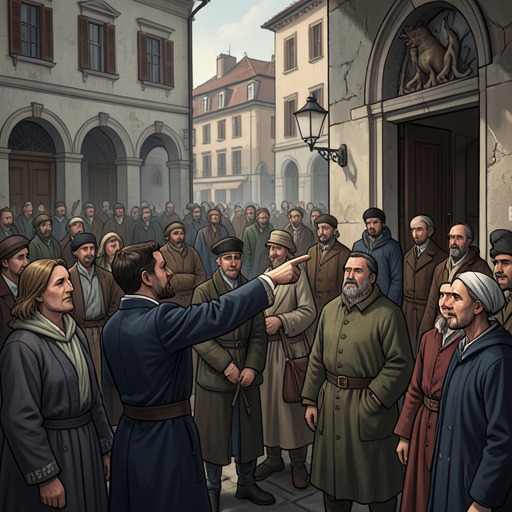
The eastbound journey of the Zhivago family carries them into a region described as unsettled and affected by recent uprisings. Patrols repeatedly stop the train to inspect papers and luggage. Its twenty-three cars sort passengers into sharply different groups: sailors travel at the front, civilians in the middle, and about five hundred labor conscripts occupy eight cars at the rear. The conscripts include people from many ages, occupations, and social positions, all grouped together under the same imposed category. The train is a moving cross-section of a society reorganized by war and political classification.
The railway does not guarantee safety or reliable passage. At Nizhni Kelmes, the train moves cautiously through snow to find the station burned out and the nearby village damaged by fire. The buildings, scattered household objects, and traces of extinguished flames show the destruction left behind, while a few inhabitants remain among the ruins. A later encounter at an unidentified station makes the danger of mistaken identity explicit: when Zhivago presents himself as a doctor from Moscow and offers his papers, an armed man dismisses them and mistakes him for a doctor associated with the guns firing on his side. Zhivago recognizes that arguing could make matters worse and withdraws. In wartime, professional identity and documents cannot protect him when authority rests on suspicion and force.
The train’s human cargo also reveals unequal exposure to the new order. Lawyers and stockbrokers share the labor-conscription cars with cab drivers, floor polishers, bath attendants, ragpickers, shopkeepers, monks, and people described as mentally ill. Some of the wealthier passengers remain confident that influential relatives or money can secure their release. The journey therefore shows not merely mass movement but the persistence of class distinctions inside a system that has nominally gathered diverse passengers under a common designation.
Civilian survival and changing daily life
In Moscow, the Zhivagos’ hardship is measured through food and fuel. For a long period, ordinary meals consist of thin millet boiled in water, soup made from herring heads, and a second course of herring; unground wheat or rye is also made into kasha. A friend teaches Antonina Alexandrovna Zhivago to bake bread in an improvised Dutch oven, hoping that sales might cover the cost of heating the tile stove. The bread succeeds, but the plan does not, and the household must return to an iron stove that smokes and gives little warmth.
Fuel becomes an errand shaped by scarcity and risk. With only two logs left, Antonina goes out to look for a village seller. In the main streets, peasants carrying produce risk arrest, so the search takes her through neighborhood alleys. She returns with a young peasant pulling a sleigh of birch logs. The wood is poor and too freshly cut to burn well, but there is no realistic alternative. In exchange, he takes her small mirror wardrobe, carrying it away as a present for his bride; while discussing a possible future sale of potatoes, he asks what the piano might cost. A household’s belongings and prospects are recast as negotiable resources.
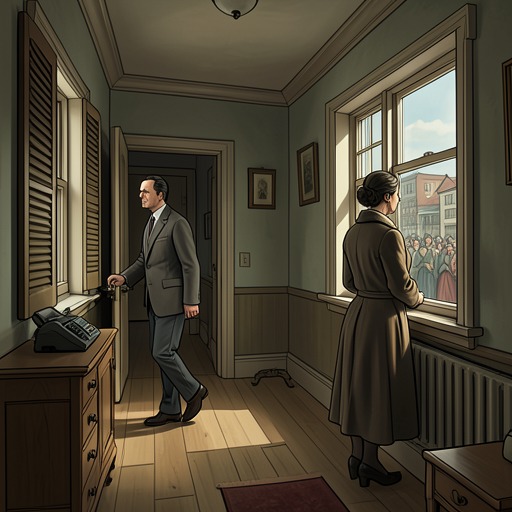
The family’s privation deepens as the civil war begins. Zhivago seeks help from a Party member whose life he had once saved, but the man is often away from Moscow and regards the hardships as a normal burden of the period. Zhivago also tries to contact a supplier on Brest Street, only to find that the young man has disappeared and his circumstances are unknown. When Zhivago finally receives an official allocation of wood, he has to fetch it from Vindava Station. He collapses while walking home beside the loaded cart and realizes that he has contracted typhus; the driver lifts him onto the wood. Even access to an allocation does not spare him from the physical cost of obtaining it.
A different encounter briefly offers relief. Zhivago and his father-in-law, Alexander Alexandrovich Gromeko, receive credit slips for goods after medical and consulting work. At a distribution center in a former army warehouse near the Simonov Monastery, they present pillowcases to be filled with flour, cereals, macaroni, sugar, suet, soap, matches, and Caucasian cheese. Carrying the supplies home, they feel that their work has made them useful and that they have earned the gratitude they expect from Antonina. The episode does not erase scarcity; it shows how access to necessities becomes bound to service, official distribution, and the household’s sense of dignity.
Memory, family, and the cost of political struggle
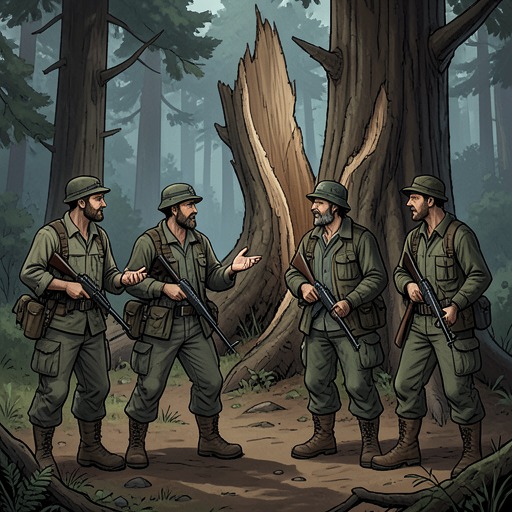
The war’s political language enters the memories of people who have crossed several phases of upheaval. Pamphil Palykh recounts a life that began with a wife, children, and work in the fields, then moved through military conscription, war, revolution, and partisan service. He says that the soldiers came to see their enemies not simply as Germans but as people closer to home, and that he joined the partisans after the revolution. His account turns from political change to fear for his family: he imagines that an enemy victory would expose his wife and children to retaliation for his own participation. The prospect of danger to them, rather than an abstract argument about the cause, becomes the immediate measure of the conflict.
That fear gains a devastating context when Zhivago recalls the killing of Pamphil’s wife and children. In the doctor’s recollection, the deaths belong to a wider sequence of executions and reciprocal atrocities in which Red and White violence answer one another. The conflict’s political divisions do not produce a moral boundary that keeps civilians safe; instead, violence generates further violence, while the doctor finds it difficult to explain the burden of witnessing it to Liberius Mikulitsyn.
The novel also presents the civil war through later, incomplete recollection. Larisa Feodorovna Antipova describes how, as the Reds approached a White stronghold in Siberia, a minister had her mother and other families sent away on a special train. Her mother, frightened and dependent on the minister, had not told him that Larisa existed. At Nagornaia Station, Larisa’s account continues, a signal woman named Marfa sheltered her after a violent incident at the signal house. Larisa stopped a passing army train by standing between the rails with a lantern and told the soldiers that help was needed; they took the assailant away, and she left on the train without retrieving her clothes. Her story is a child’s experience of the war’s unstable protections, carried into adulthood as a personal history of flight.
The framing of the novel’s later recollections adds another perspective on what the conflict has done. Misha Gordon and Innokentii Dudorov recognize Tania as Zhivago’s daughter, and Gordon remarks that a once-figurative phrase about the children of Russia’s terrible years has become literal: children are now children, and the terrors are actual. The comment links political upheaval to the exposed lives of the young, including those whose parentage and histories have been obscured by displacement. Across the novel, the Russian Civil War is thus registered in battlefield misidentification, exhausted medical work, coerced movement, depleted households, and memories that outlast the armies themselves.